A Windblown Scots Pine Crown Lodged in Beech
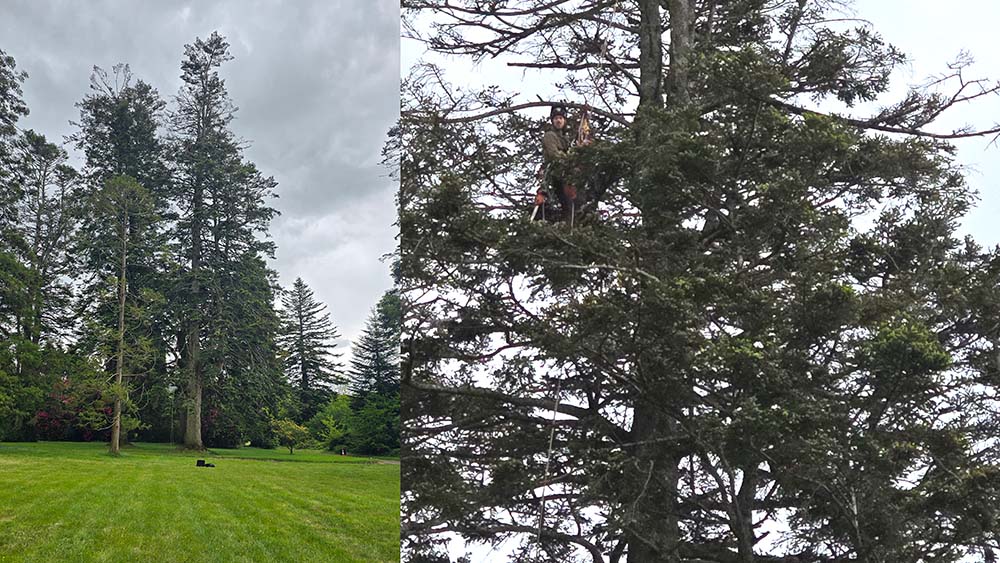
One of the most interesting and precarious jobs on the site involved a mature beech tree, Fagus sylvatica, located on the rear access route between the Wellfield and the Lost City area.
A storm-damaged Scots pine, Pinus sylvestris, had lost a large section of its crown, and the entire top had blown out and lodged high in the crown of the beech. These were not small branches. We were dealing with long, heavy sections of pine, some around 40 feet in length and up to two feet in diameter, sitting awkwardly at height in another tree.
At first glance, climbing directly into the situation did not seem like the safest option. The priority was to make the tree safer before committing a climber to the canopy.
We used a throwline to place a rope over one of the lodged limbs, then pulled in a light rigging rope, followed by a heavier rigging rope. We redirected the line through a pulley and used the tracked wood chipper to apply controlled pulling force from the ground.
After several adjustments and changes of angle, we managed to bring the first large section down significantly. It was still jammed at an angle in the beech, but it had moved from the very top of the crown to a much lower and safer position.
We repeated a similar process with another large section of pine. By pulling from different angles and cutting accessible sections from the ground where possible, we removed much of the hazard without exposing climbers to unnecessary risk.
Only once the worst of the loading and tension had been dealt with did we climb above the remaining sections and cut them out using standard climbing techniques.
This was a great result for Rebel Tree Care. It showed the value of patience, planning, rigging, and not rushing into a climb just because a tree needs to be climbed eventually. Whether it is storm-damaged trees, emergency tree removal, dangerous tree cutting, or complex dismantling, planning the work correctly is what keeps people and property safe.
Directional Felling Near the Lost City
In the Lost City area, we also dealt with a group of mature dead fir trees.
The goal here was to remove them as efficiently as possible while avoiding damage to neighbouring trees. We opted for directional felling. A climber accessed the tree first, removing lower branches that could snag during the fell and installing a pulling line high in the stem.
We then set up a redirect using a pulley to the wood chipper, applied tension through the rigging line, and combined that with accurate felling cuts and wedges.
The tree came down exactly where intended. It was a clean fell, with no damage to the surrounding trees. Once on the ground, we processed the timber and left a usable 20-foot length for the festival team to potentially use as building material. The remaining canopy material was mulched into rough chip.
This was a good example of controlled tree removal, where the safest and most efficient option was to fell the tree directionally while protecting the surrounding trees and site features.
Beech, Scots Pine, Ash, Sycamore, and More
There were several other jobs completed across the site during our visit.
One beech tree over a campsite access route had a dead main stem. I accessed the living section of the tree and removed the dead stem from there. The weather had picked up by that stage, with strong winds moving through the canopy, but conditions remained within a safe working limit and the job was completed successfully.
At the same time, another climber accessed and deadwooded a Scots pine in the Wellfield.
Elsewhere, near the access route to Stage 3, another climber worked on a mature diseased ash with a large codominant stem. The union had a significant included-bark fault line, and if that stem had failed naturally, it could have caused serious damage in a public area. The work was completed successfully and the risk was reduced.
Across the wider site, Rebel Tree Care carried out further ash removals, oak deadwooding, crown raising on sycamores, removal of small dead trees, and work on several medium and mature trees throughout the festival grounds.